Hook Knife: The Curved Blade That Hollows Spoons and Bowls
Of the five blades in the CarveKind carving kit, the hook knife is the one that confuses new carvers most — it looks wrong until the first time you use it, and then it's obvious. This page covers what the curve is actually for, what you can carve with it, the basic technique for hollowing your first spoon, and how it fits alongside the straight blades covered on our wood carving tools page. Short version: if you ever want to carve anything with an inside, this is the tool that makes it possible.
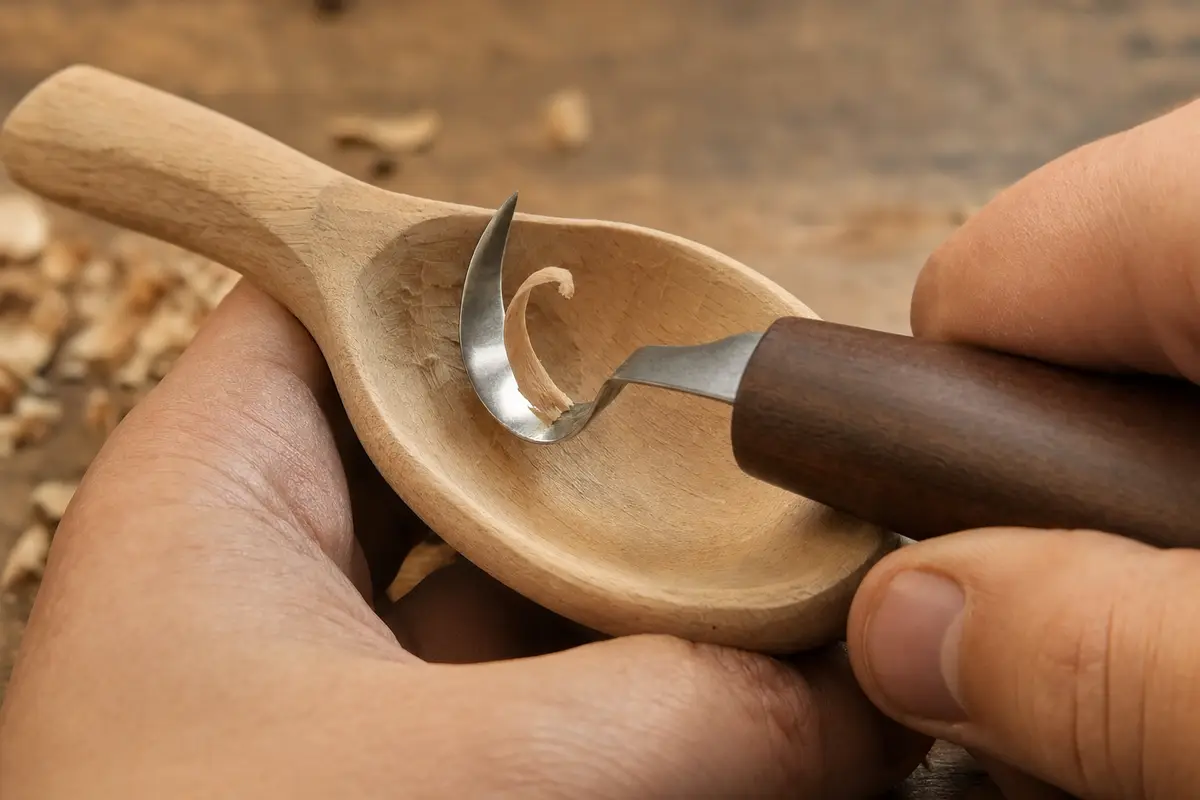
Why a curved blade at all
Think about what happens when you try to hollow a spoon bowl with a normal knife: the straight edge bridges across the hollow, contacting the rim on both sides while the middle of the blade floats. You end up stabbing and levering instead of cutting, which tears the grain and eventually cracks the blank. The hook knife inverts the geometry. Its sweep matches the concave surface, so the edge stays in contact with the wood through the whole stroke, shearing fibers cleanly even where the cut runs across the grain — which, in a spoon bowl, most cuts do. That's the entire reason this blade shape has survived unchanged in Scandinavian spoon carving for generations: nothing straight can do its job.
What you can carve with a hook knife
Spoons are the classic first project, and for good reason — one blank, two knives, and a finished object you'll actually use. A verified CarveKind buyer in Brazil got there almost immediately: "Great product, it arrived and I already made a spoon with a piece of wood that I had saved." From spoons, the same skills scale to ladles and scoops, then to kuksa cups and small dishes, which are just wider, deeper hollows worked in more sessions. The full progression, blank selection included, is laid out in our spoon carving guide, and the best wood for carving guide covers which species make the learning curve gentler.
Basic hook knife technique: hollowing your first bowl
- Shape the blank first. Use the sloyd knife to rough out the spoon's profile — handle, neck, and the outside of the bowl — before you hollow. A defined rim gives the hook knife something to work against.
- Start the hollow at the center. Anchor the blank against your bench or thigh guard, and open the hollow with short, shallow sweeps in the middle of the bowl, where the blade can't skate off the edge.
- Work from rim toward center, across the grain. Take thin shavings, not deep bites — depth comes from repetition, and thin cuts leave a surface that needs almost no cleanup. Rotate the spoon between strokes rather than contorting your wrist.
- Cut away from your body, every stroke. Keep the hand holding the blank behind the edge, never in front of it, and wear a carving glove on that hand while you're learning. A freshly stropped edge helps here too: sharp blades go where you steer them, dull ones slip.
- Finish the rim last. Once the depth is right, take whisper-light passes around the rim to even the wall thickness, then switch to the trimming knife for the final smoothing.
If some of those terms are new, our beginner's guide to wood carving covers grips and cut types from zero.
Hook knife vs. straight knife vs. bench gouge
| Tool | Edge | Can it hollow a spoon bowl? | Where it shines |
|---|---|---|---|
| Hook knife (in the kit) | Curved sweep | Yes — held in the hand | Spoon bowls, kuksa, scoops, small dishes |
| Sloyd knife (in the kit) | Straight | No | Profiles, handles, whittling, roughing out |
| Bench gouge (not included) | Curved, mallet-driven | Yes, with the blank clamped to a bench | Larger bowls and volume removal at a workbench |
Honest boundary: a hook knife is a hand tool for hand-scale hollows. If your ambition is a full-size salad bowl, you'll eventually want a clamped blank and a gouge — that's a different workflow, not a bigger hook knife. For everything from eating spoons up to kuksa cups, though, the hook knife is the right tool and the traditional one.
Keeping the curved edge sharp
A hook knife earns its keep cutting across the grain, which dulls any edge faster than slicing along it — so routine stropping matters even more here than with the straight blades. The chrome vanadium edge maintains well: a minute on the included grinding leather with the green polishing wax, worked along the curve in sections, brings back the bite. One Danish buyer's review called out the sharpening gear specifically: "Sharpening leather is multilayer." The full curved-blade routine is on our leather strop and compound page, with a longer treatment in the blog's knife sharpening guide.
The hook knife in the CarveKind kit
The hook knife ships as one of five chrome vanadium blades in the CarveKind 8-piece kit, alongside the sloyd, chip carving, oblique, and trimming knives, plus the strop, polishing wax, and canvas roll bag — included in the CarveKind 8-piece kit, no need to buy a spoon knife separately. The square black walnut handle matters more on this blade than any other, because hollowing is sustained-pressure work; as a Korean buyer put it, "the blade is sturdy and the large handle is comfortable for applying force." The kit is $39.99 against a $59.99 compare price, ships free in the US in 3–11 business days, and carries a 30-day money-back guarantee. Buyer photos — including that Brazilian first spoon — are on the reviews page.
Average monthly US searches for 'hook knife' — plus 720 more for 'spoon carving knife'
— DataForSEO keyword data, 2026
Average rating across 192 verified buyers of the CarveKind 8-piece kit
— CarveKind verified buyer data, 2026
CarveKind carving kits sold to date
— CarveKind sales data, 2026
free shipping to the US · 30-day money-back guarantee
See how we test for the criteria behind every claim on this page.
Hook knife FAQ
Is a hook knife the same as a spoon carving knife?
Yes — "spoon carving knife" is the everyday name and "hook knife" is the traditional one; both describe a knife with a curved blade used to hollow concave shapes. Some catalogs also call it a spoon knife or crook knife. Whatever the label, it is the tool that scoops the bowl of a spoon, and one is included in the CarveKind 8-piece kit.
Can you carve a bowl with a hook knife?
Small ones, yes. A hook knife works held in the hand, so it suits spoon bowls, kuksa cups, scoops, and palm-sized dishes. For large bowls, carvers switch to bench tools — a heavy gouge or an adze with the blank clamped down — because hollowing that much volume by hand-held knife alone becomes slow and tiring.
How do you sharpen a hook knife?
The same principle as any carving blade — stropping with a polishing compound — but worked along the curve in sections instead of flat. The leather strop and green polishing wax included in the CarveKind kit handle routine upkeep; our sharpening guide covers the curved-blade technique step by step.
What wood is best for spoon carving?
Soft, straight-grained hardwoods are the classic choice — birch is the traditional spoon wood, and basswood is the easiest to learn on. One CarveKind buyer in Brazil reported carving a spoon from a saved scrap on day one. Our best-wood-for-carving guide compares the common species in detail.
Related pages
The full kit lives on the wood carving knife homepage, with every blade type explained on the wood carving tools page. Straight-blade work is covered on the whittling knife page, and edge maintenance on the leather strop page. For projects, start with the spoon carving guide.